Bill Nieman, Natalie Robinson, Angel Ramos, Sherri Danico, Todd Trowbridge, Jessica Gonzalez
CPMGT /304 May 19, 2019 Jamie Dorman

How is creativity measured?
Creativity is not easily measurable compared to Intelligence Quotient (IQ) testing where a series of questions on a test can measure your intelligence. What one or more characteristics in one creative individual may not be present in another individual who is just as creative. However, assessing the different aspects of creativity, ranging from cognitive processes to environmental factors, the most noticeable characteristic of individuals is their diversity (Said-Metwaly, Kyndt, & Van den Noortgate, 2017). Creativity can be measured by a person’s ability to successfully resolve a problem by presenting something new, original, and at times unusual regardless of certain risks. Creativity can be measured at the individual, team, or organizational level. Let us use an architectural example to measure an individual’s creativity. If an architect was to design a dwelling for a five-member family that has high ceilings, a sense of openness and must take advantage of year-round sunny weather when complete we can measure the architect’s sense of creativity based on the aforementioned requirements. The results are quantifiable in that we can measure; how much sunlight enters the house, how were the ceilings addressed, and if the house has an open feel or is it more claustrophobic.
Identify the four general conceptual domains into which new ideas can be classified.
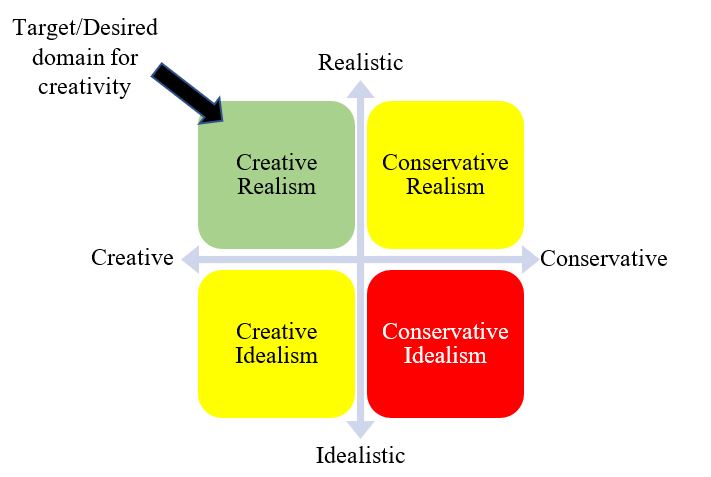
There are four general conceptual domains into which new ideas can be classified. These four domains represent the continuum between very traditional ideas considered conservative and the highly original ideas considered creative (Thompson, 2003). Thompson (2003) shares that within these four domains is the difference between new ideas that are connected to existing knowledge which is considered realistic and the far-fetched ideas that are not realistic but considered as idealistic. The figure below represents the four domains in which new ideas fall.
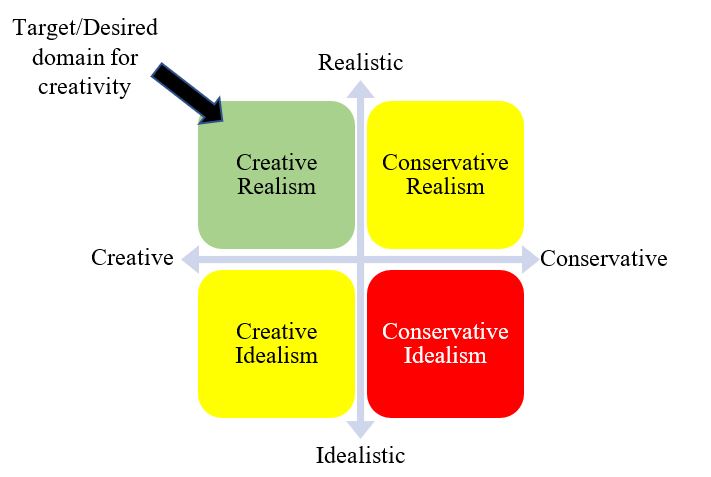
The ideas that fall within the creative realism domain are considered exceedingly imaginative while being decidedly connected to structures and ideas (Thompson, 2003). Operating within this domain is where businesses want their people to be when creating new ideas and concepts (Thompson, 2003). The ideas that are generated within the creative realism are original and useful to develop solutions (Thompson, 2003). The Creative Realist (2011) in their blog defines identifies creative realism as “the ability to apply thoughtful, innovative, and creative ideas to real-world practical situations while being influenced by actual data and consequence” (para. 3). Thompson (2003) notes that the path to get to this quadrant is indirect and not obvious for those trying to steer teams towards this domain.
The conservative realism conceptual domain is where extremely traditional ideas that are generated by individuals or teams fall into. The types of ideas generated within this domain are connected to the current knowledge and practices existing within the business. When analyzing the ideas, they leave little doubt about their ability to function. They do not push the envelope enough to be truly creative in generating new concepts. Another conceptual domain is the conservative idealism when classifying new ideas (Thompson, 2003). From a business perspective, ideas falling into the conservative idealism domain are considered the worst type of thinking because the ideas generated that fall into this category have very little imagination if any at all. The ideas generated falling into this category while not showing creativity also lack being realistic solutions that can be deployed with no connection to existing knowledge (Thompson, 2003). The last of the four conceptual domains is titled creative idealism which highly original ideas fall within. The challenge with ideas that fall into this domain as that those ideas are incredibly unrealistic. The Creative Realist (2011) describes the ideas that are generated and fall within this category as being from a fictional or fantasy world.
Threats to team creativity

There are several threats to team creativity in an organizational environment. When a team of experts or subject matter experts is gathered, they bring with them a diverse skill set and methods to complete tasks. The also sometimes bring with them the preconceived idea that their way is the best way to do things. The problem here is that they are often not disposed to bounce ideas off each other with an open mind. These experts will often be listening to steer the conservation back to their solution. Another threat to team creativity is organizational restrictions. Often an organization will have company standards for doing things. They may have standard practices. In doing this, they are telegraphing to the teams not to bother coming up with creative solutions because they will never be implemented. Lastly, the easiest way to kill a teams creativity is to have a bully manager. In this environment, the manager hands out tasks to be done to complete a job. They are not interested in the team’s opinion or input, just their output.
Ways teams can enhance creativity
There are several ways to enhance project team creativity. Encourage team members to be creative. Make sure that everyone’s ideas are heard, discussed and given merit. By supporting creativity, this makes team members feel that their ideas are important and add value to the team. Facilitating different ways of working is another way to inspire creativity. When you allow people to choose how they work—so long as they do their jobs and do them well—they’re happier, and that can prompt more creativity (Fridman, 2016).
  References
 Creative Realist. (2011) Creative Realism – What the hell are you talking about. Retrieved from     http://www.creativerealist.com/post/13733807290/creative-realism-what-the-hell-are-you-talking

 Finke, R. A. 1995. Creative realism. In S. M. Smith, T. B. Ward, & R. A. Finke (Eds.), The creative cognition approach: 303–326. Cambridge, MA: MIT Press

 Thompson, L. (2003). Improving the creativity of organizational work groups. Academy of Management Executive, 17(1),96109. https://doi.org/10.5465/AME.2003.9474814

Fridman, A. (2016, April 25). Three Ways to Foster Creativity in Your Team. Retrieved from Inc.com: https://www.inc.com/adam-fridman/3-ways-to-foster-creativity-in-your-team.html

 Group 1